
Overview
SDR Hwæt is a software-defined radio receiver for Windows. Plug in an SDR such as an RTL-SDR dongle and it becomes an FM, medium-wave, shortwave and DAB+ radio, a weather-satellite image receiver, a digital TV set, and a general-purpose receiver for the airband, marine and amateur bands.
Broadcast
FM with stereo and RDS, medium wave, shortwave and DAB/DAB+, with one-click station scan.
02Weather satellites
Images from METEOR-M2, GOES-18/19 and GK-2A, with pass prediction and automatic reception.
03Digital TV
DVB-T, ISDB-T and ATSC, with channel scan, programme guide, snapshots and recording.
04Receiver
Nine demodulation modes, band presets, bookmarks, and audio or I/Q recording.
Broadcast
Choose FM, MW, SW or DAB in the sidebar and press Scan stations; every station found is listed with its signal strength. FM plays in stereo and shows the RDS station name and programme type. The spectrum and waterfall show the whole band, and clicking a peak tunes to it.
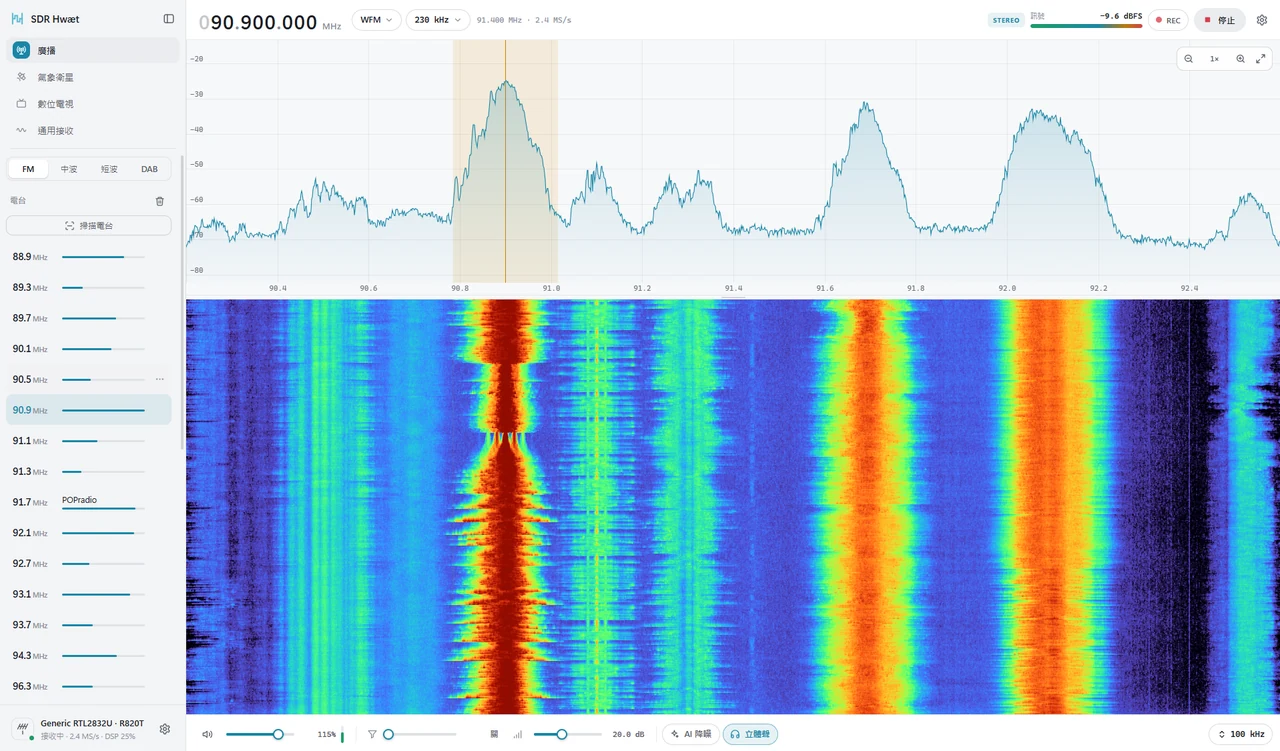
AI denoise removes the hiss from weak stations. It runs DeepFilterNet3 through OpenVINO on the Intel NPU when the computer has one, and falls back to the GPU or the CPU.
Weather satellites
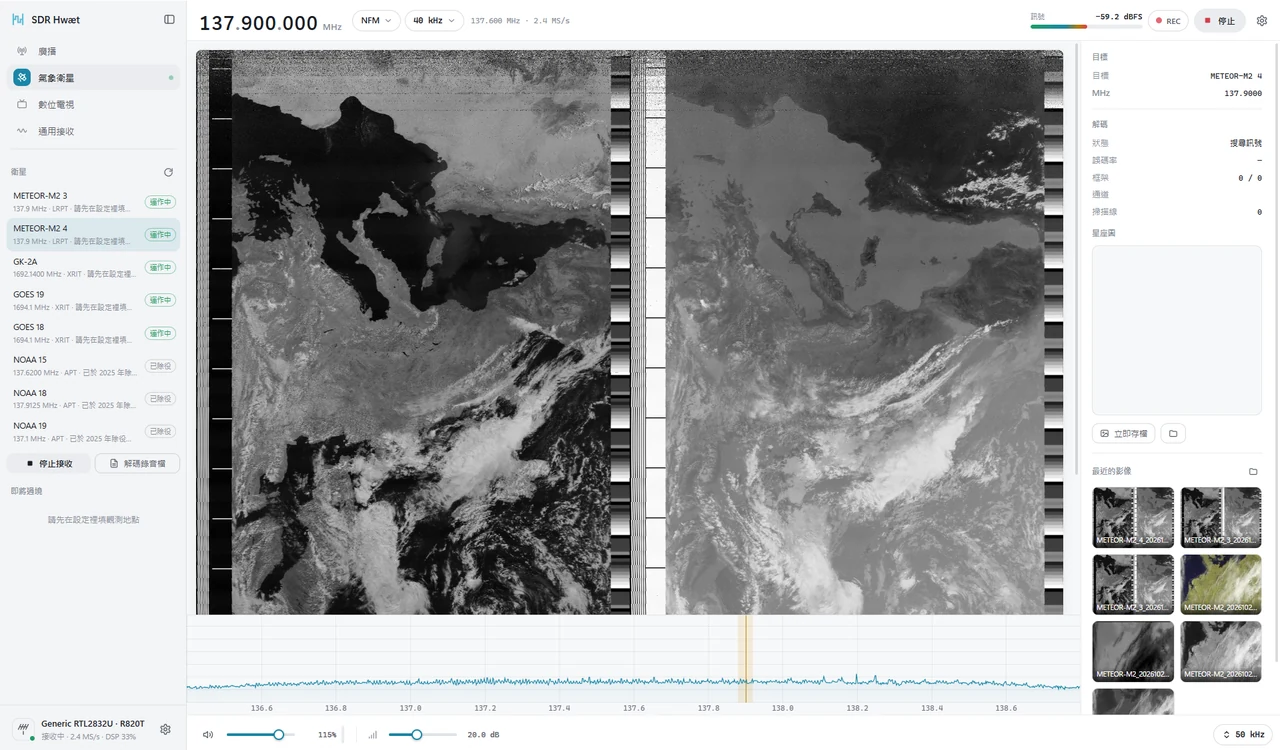
The satellite list shows each satellite's frequency and status, and the passes coming up over your location. Orbital elements are downloaded from CelesTrak and passes are predicted with SGP4. With automatic reception on, SDR Hwæt starts receiving when a satellite rises and saves the image as a PNG when it sets. Recordings can be decoded afterwards as well.
| Satellite | Signal | Notes |
|---|---|---|
| METEOR-M2 3, M2 4 | 137.9 MHz LRPT | Polar orbit; a 137 MHz antenna is enough. |
| GOES-18, GOES-19 | 1694.1 MHz HRIT | Geostationary; needs a dish pointed at the satellite. |
| GK-2A | 1692.14 MHz LRIT | Geostationary; needs a dish pointed at the satellite. |
| NOAA 15, 18, 19 | 137 MHz APT | Retired in 2025; recordings can still be decoded. |
Digital TV
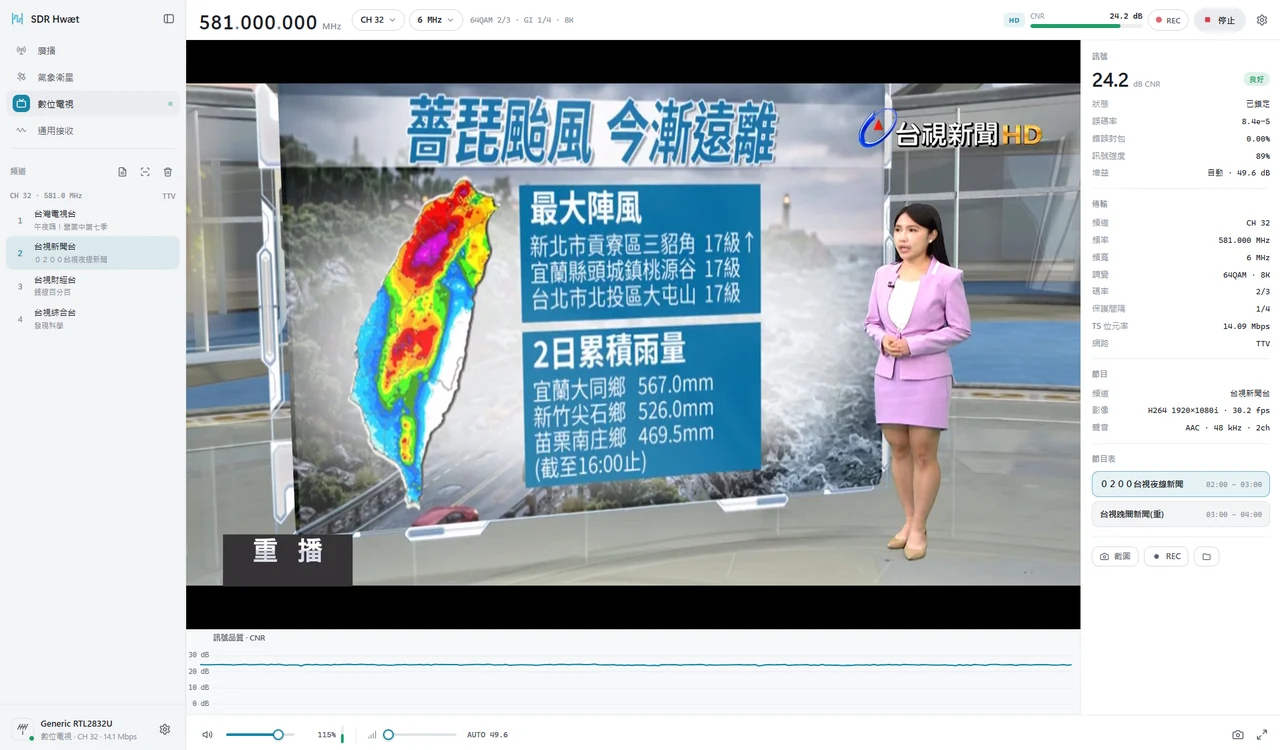
Scan the channels for your region, then pick a programme. The panel on the right shows signal quality, modulation, bit rate, video and audio formats, and the programme guide. Snapshots, recording the current programme or the whole multiplex, and full screen are one click away. Recorded TS files can be played back too.
| Standard | Regions | Demodulation |
|---|---|---|
| DVB-T | Taiwan, Europe, Australia | The RTL-SDR's own hardware demodulator; software on other SDRs. |
| ISDB-T | Japan, Brazil | Software. Narrow devices such as the RTL-SDR receive the 1-seg layer. |
| ATSC | United States, South Korea | Software. Needs an SDR that covers 6 MHz, such as Airspy, HackRF or ADALM-Pluto. |
DTMB, used in China, is not supported.
Receiver
For everything else, tune anywhere the device reaches and choose a demodulation mode and bandwidth. Presets cover the airband, marine VHF, amateur 2 m and 70 cm, PMR446, CB, AIS and ADS-B, and any frequency can be bookmarked.
| Mode | Typical use |
|---|---|
| WFM | FM broadcast. |
| NFM | Two-way radio, amateur and marine VHF. |
| AM, sync AM | Airband, medium wave and shortwave. |
| USB, LSB, DSB | Amateur and utility sideband stations. |
| CW | Morse code. |
| I/Q | Raw I/Q, for recording a signal to decode later. |
Audio and I/Q can both be recorded. I/Q recordings are WAV files with the same layout as SDR# and HDSDR, so they open in either program, and SDR Hwæt plays them back as a signal source.
Supported devices
| Connection | Devices |
|---|---|
| USB | RTL-SDR (RTL2832U), Airspy R2 / Mini, Airspy HF+, HackRF One, SDRplay RSP series, ADALM-Pluto, and LimeSDR, bladeRF or USRP through SoapySDR. |
| Network | rtl_tcp, SpyServer, KiwiSDR, Hermes-Lite 2. |
| File | I/Q recordings (WAV) and MPEG-TS. |
Drivers. The installer can add the WinUSB driver for the RTL-SDR, so the dongle works as soon as it is plugged in. The SDRplay RSP series needs the SDRplay API, and SoapySDR devices need PothosSDR.
SDR Hwæt can also share its RTL-SDR on the local network as an rtl_tcp server, for SDR#, SDR++, GQRX or another copy of SDR Hwæt.